Zuni Fetishes (5 of 5)

Zuni FetishOne final though on the topic of Zuni Fetishes

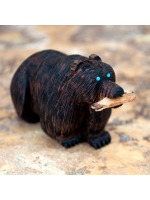
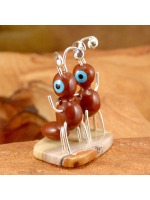
The artist’s styles are as unique as the artists themselves, and there are many whose works are highly sought after by collectors. Some collectors prefer a figure that is more realistic in appearance, while others prefer the more traditional styles that are intrinsic to Zuni belief. The traditional belief of the Zuni is that the least modification of the original material maintains, or heightens, the power of the fetish as a “natural concretion”.

Now that you have a better appreciation for these little works of art, perhaps you’ll find yourself drawn towards one the next time you are shopping for your favorite turquoise jewelry.  Feel free to write me and let me know what you’ve found.  I love hearing all the great stories of finding treasured pieces!
Did you like this? Share it:
Posted in Information and Education | Leave a comment

Zuni Fetishes (4 of 5)

Zuni FetishOn the subject of feeding, tradition tells us that the fetishes require a meal of cornmeal and ground turquoise periodically. Also, tradition says that Zuni fetishes should be kept in a clay pot, although today most people keep their fetishes somewhere where they can be enjoyed and admired. Any but the very delicate fetishes could be carried in a pocket, pouch or bag. Even today, I have the very first fetish that I ever purchased in the pocket of my favorite jacket.  Each winter it’s like a little surprise when I first put my hand into the pocket and find it all over again.  Then again, perhaps I’m getting old since I forget about it every summer!

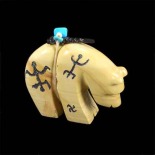
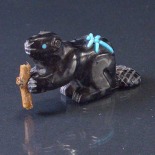
Besides being made from various stones and other materials (each material has its own unique properties), the contemporary fetish may carry an offering of a smaller animal or a prayer bundle of carved arrowheads with small beads of heishe. It may be adorned with a heishe necklace, feathers, etchings representing ancient petroglyphs, or an etched or inlayed heartline. These small items, although colorful to the eye, are intended to protect and feed the fetish itself.

Did you like this? Share it:
Posted in Information and Education | Leave a comment

Zuni Fetishes (3 of 5)

Continuing on the topic of Zuni Fetishes

Each animal is believed to have inherent powers or qualities that may aid the holder. The Navajo, for example, treasured and bartered for figures of horses, sheep, cattle or goats to protect their herd from disease and to insure fertility. The Zuni hunter was required to have his fetishes with a “Keeper” and practice a ceremony of worship when procuring a favorite or proper fetish to aid in a successful hunt.

Today many people find themselves drawn to certain fetishes for one reason or another.  Often, for no specific reason, a fetish will be created (or purchased) simply because it seems to have ‘called’ to us.  This very spirit within each fetish is what makes their popularity today as strong as it has been for more than a century.  I have run across many of my most cherished fetishes while shopping for turquoise jewelry.  I hadn’t planned on purchasing a fetish, but there it was, and I knew it was mine!

Did you like this? Share it:
Posted in Information and Education | Leave a comment

Zuni Fetishes (2 of 5)

Zuni FetishThe materials used by carvers were typically indigenous to their home region.   However, as trade became popular among various tribes, and even across country boarders (what we consider to be country boarders today) the carvers would trade for materials not available in their pueblo.

The most important material used for carving was turquoise (similar to the popularity of turquoise found in turquoise jewelry), which is considered by the Zuni to be the sacred stone. Jet, shell (primarily mother-of-pearl), and coral are also frequently used. These materials and their associated colors are principle in the Zuni sunface, a cultural symbol which is present in Zuni jewelry and fetishes and represents their sun father. Other materials used to make Zuni fetishes are Zuni rock (rock found on the Zuni pueblo in New Mexico), fishrock, jasper, pipestone, marble, or organic items such as bone and deer or elk antler.

Did you like this? Share it:
Posted in Information and Education | Leave a comment

Zuni Fetishes (1 of 5)

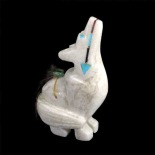
Zuni CarvingToday I thought I would give a little information on Zuni fetishes. I first thought about diving right in and talking about the Buffalo and its importance in carvings and fetishes, but I think it best to first give some information on fetishes and carvings in general.  In the traditional sense, Zuni fetishes are small carvings made from various materials by the Zuni Indians. These carvings serve a ceremonial purpose for their creators and depict animals and icons integral to their culture. As a form of contemporary Native American art, they are popular worldwide.

Zuni fetishes depict animals such as the wolf, badger, bear, mountain lion, eagle, mole, frog, deer, ram, and many others. There are many more animal subjects used by today’s contemporary carvers that may include insects, non US native animals such as lions, or even animals of the oceans such as sharks; these would be considered non-traditional. Other animals, such as the horse, were carved mainly for trade. The Zuni was not a horse culture but their horse carvings were considered by the horse cultures to the north as having great power for the protection of their herds.

If you’d like to see some of these wonderful carvings right away, you can see some fantastic examples Turquoise Canyon, www.turquoisecanyon.com

More to come…

Did you like this? Share it:
Posted in Information and Education | Leave a comment

Zuni Petit Point, Snake Eye & Needle Point Techniques (5 of 5)

The third technique, needle point, requires the highest level of skill to achieve success. Like the other Zuni jewlery techniques, petit point and snake eye, needle point has been made possible by finer tools that allow for extremely delicate stone carving. Needle point requires thinly sliced cabochons with finely polished and finely pointed ends. The very nature of the shape, as well as the number of cuts necessary to achieve the correct shape, requires a great amount of patience and skill. Artists that are new to needle point can expect to create 10% usable cabochons. The remaining 90% will be shattered and broken pieces. These small broken fragments are usually too small to be reused and are used for purposes other than jewelry (example: for turquoise fill used in pottery, or turquoise pigment for dyes and paints). Once the artist gains experience, the waste pile shrinks and the cost to create each usable cabochon shrinks as well.

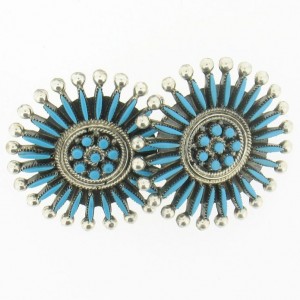
Needle point cabochons are set in a vertical setting. When viewed from above, each small pointed stone appears to be a small sliver of polished work. Each stone looks to be a turquoise needle that has been placed into a sterling silver setting; and thus the name needle point has been given to this technique.

Because of the difficulty in crafting needle point cabochons, certain mines of turquoise are more popular to be used in turquoise jewelry. These include sleeping beauty, lone mountain, and spider web.

Did you like this? Share it:
Posted in Information and Education | Leave a comment

Zuni Petit Point, Snake Eye & Needle Point Techniques (4 of 5)

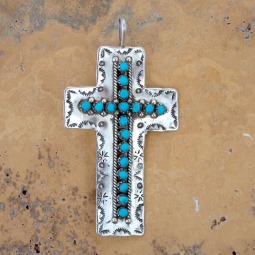
The snake eye technique found in Zuni jewlery requires the same level of stonework skill as petit point, but creates a cabochon that resembles a sphere, or dot; thus looking like the eyes of a snake when finished. Typically an artist will create a small cylinder shape and then polish one of its ends round. The cabochon can then be cut to the necessary height. Once set in its sterling silver setting, the cabochon appears to be a small highly polished sphere.  The sterling silver cross penant pictured to the right is a great example of the snake eye technique in turquoise jewelry.

Did you like this? Share it:
Posted in Information and Education | Leave a comment

Zuni Petit Point, Snake Eye & Needle Point Techniques (3 of 5)

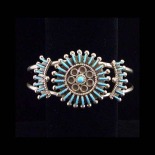
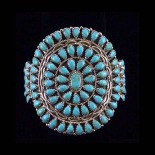
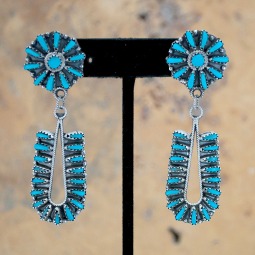
The petit point technique creates a small cabochon with one end rounded and the opposite end carved and polished to a point. It could be described as looking like a tear drop. The finely crafted cabochon is then placed in a setting, typically sterling silver. Petit point cabochons lend themselves to round designs such as the classic cluster bracelet like the one seen to the right.

The petit point technique found in Zuni jewelry requires finely honed stonework skills. The cabochons are very small and can easily fracture during the honing and polishing process. Each jewelry artist has created their own method of forging these small pieces and once mastered, will typically sit and create hundreds of the polished stones all at once in preparation for creating a finished piece of turquoise jewelry.

Did you like this? Share it:
Posted in Information and Education | Leave a comment

Zuni Petit Point, Snake Eye & Needle Point Techniques (2 of 5)

Zuni Needle Point Petit PointSilver work began to be seen in Native American turquoise jewelry during the mid 1800’s. It was introduced by artists from Mexico, as well as neighboring tribes who had taught themselves and shared their skills. The tools used during this time were not capable of creating the finely intricate patterns seen in later years (such as the picture to the right).  Therefore, much of the Native American jewelry in the 1800’s was polished stone with silver work being forced to accommodate the natural shape of the stone.

In the mid-1900s, the 1930’s and 1940’s, better hand tools, as well as electric tools began to be used by the Native American jewelers. These tools allowed for a much greater level of precision when working with stones and allowed the jewelers to make the stones fit into their designs, instead of the artists’ vision being forced to use the stones natural shape.

With the new skills and new tools, the petit point technique began to be seen in Zuni jewlry.

Next time, the petit point technique….

Did you like this? Share it:
Posted in Information and Education | Leave a comment

Zuni Petit Point, Snake Eye & Needle Point Techniques (1 of 5)

Zuni Petit Point Needle Point Over the next few posts, I’d like to share some information about the differences in three very popular Zuni jewelry techniques which are often confused; petit point, snake eye, and needlepoint. These three stone setting techniques offer exquisite detail in a finished setting and are instantly recognizable.

The turquoise and other stones used in all three of these turquoise jewlery techniques are called cabochons. Cabachon is a jeweler’s word for a stone that is polished instead of faceted. A faceted stone, such as a diamond, is called a gemstone. Cabochons are small polished stones and are the basis for petit point, snake eye and needle point Zuni work.

Next time, a little history.  Then, the fun stuff…..

Did you like this? Share it:
Posted in Information and Education | Leave a comment