As always, we like to feature new and fun types of turquoise jewelry; and here’s on that I really like a lot. Â By Zuni artist Gilbert Calavaze, this is a pueblo style Zuni bracelet. Â This Zuni bracelet is item number 220420. Â Enjoy!!!
here
As always, we like to feature new and fun types of turquoise jewelry; and here’s on that I really like a lot. Â By Zuni artist Gilbert Calavaze, this is a pueblo style Zuni bracelet. Â This Zuni bracelet is item number 220420. Â Enjoy!!!
here
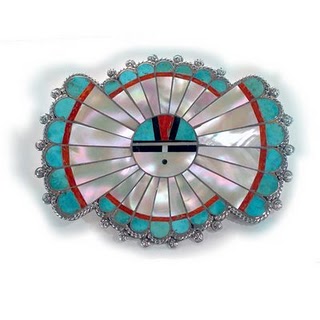 A third basic form for the Zuni Sunface is an oblong or oval shape. The Sunface’s face remains center to the piece, but the outer design is created to give a wider setting. This is typically seen on bracelets and bolo ties. It is more rarely seen in other forms of jewelry. This image gives an even stronger symbolism to the eagle. The wider spread of the setting can represent the wings spreading wide to take flight. Another interpretation is that the wider sections represent the arms of the Sunface reaching out to embrace the world and the Zuni people.
I’ve only scratched the surface of the fantastic Sunface discussing just a few of the common designs and only several suggestions as to the importance it will have to the artist who created it and the person who wears it. Of course there are thousands, and maybe millions of different styles of Sunfaces, each as unique as its artist and its wearer.
I hop that you have enjoyed these past few posts about turquoise jewelry, and specifically, the Zuni Sunface.
This is the third in a series of four articles concerning the Zuni Sunface; a very popular style of turquoise jewelry.  Beyond the center face, the overall Zuni Sunface design can take on several forms. The most common is the full circle. In this design the center face will be surrounded by a fully symmetrical design typically accented by a feather like design. These feathers will often be split and represented by two or more cabochons. This design creates several meanings. First, the most obvious is the form of the Sun itself; the central Sunface surrounded by beams of light, shining down upon the Zuni. Another interpretation is that the feather design offers the Sunface freedom to soar and glide through the sky thus enabling him to create sunrise and sunset. From this comes another interpretation – the Sunface associated with birds, and most commonly the eagle. Thus, as an eagle, the Sunface is both wise and powerful.
 The second basic form for the Sunface is where the outer circular design does not complete a full circle. Instead it stops around the 5 o’clock and 7 o’clock positions. This gives the appearance of a headdress. Two feather designs, almost like earrings, are usually found in this style as well. This style is no more or less important that the full circular design. This style represents the Sunface as a decorated god, wearing a headdress and can be thought to show Sunface decorated as a god. Another interpretation is that the partial circular design represents the sky as seen above a horizon. The earring like feather design can be the clouds and rain, giving life to the earth. When worn as a ring or bracelet, the wearer’s fingers or wrist can then represent the earth.
 From a craftsmanship perspective, the Zuni Sunface is one of the pinnacles of Zuni inlay artistry; and is prized among those who appreciate turquoise jewelry.. It requires exacting cuts and an extremely high level of skill to appropriately create the fine inlay used in the Sunface. Most typically the Sunface is crafted in a full circular motif. The center inlay will represent the face of the Sun. The forehead is usually split into two (sometimes three) sections. Depending on the complexity and size of the piece, the two sections can be single cabochons or can be finely inlaid works in and of themselves. The two sections represent two important concepts. The first is the pairing of oneself with the family. Family is as critical to life as food and water to the Zuni people, yet they also understand that each person is unique and special. Each one requires the other, and as such, both become represented as a main component of the Sunface. The other meaning is to symbolize the coming and going of the sun; sunrise and sunset or the day and night. The continuity of these events gives hope and stability to the Zuni, and again, neither can exist without the other.
The remaining lower section is made up of the eyes and mouth. The eyes are most typically represented as long rectangular shapes almost always crafted in black (either jet or onyx). These “slits†are the eyes of the Sun, peering out upon all of us. The Zuni do not add detail to the eyes for reasons of respect. The eyes are “windows of the soul†and as such an artist cannot assume to know what lies within. Therefore they are represented by the black rectangles. The mouth is typically round, but can be crafted out of almost any stone. This is the same for the remaining section of the face. Mother of pearl is most common, but all stones have been used. The mouth is fashioned as a simple circle for several reasons. First, this maintains the continuity represented by the Sunface; the circle representing the cycle of life and death, day and night. Another reason often associated with the simple circle design of the mouth is that the Sun is neither good nor bad, and thus no smile or frown is associated with the Sunface. It is simply a mouth.
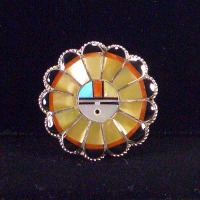 For the next few posts, I’d like to share some information about the Zuni Sunface, its symbolism and importance to the Zuni people; and its importance to anyone that gets caught staring at its fine craftsmanship. The Sunface can be seen in many different Zuni art styles from pottery to rugs, and of course in turquoise jewelry. Because of its great importance the Sunface has been used in almost every type of jewelry that can be crafted.
The Zuni, like most Native American people, were centered in an agricultural life style. This required them to have a keenly sharpened understanding of the relationship between the seasons and their crops. The Sun plays the penultimate role in this relationship, and is therefore considered one of the most important beings to the Zuni culture. The Sun is the bringer of life, stability, and continuity. The Sun brings prosperity and joy to families, and playfulness to children. The Sun affords the Zuni good luck and fortune. To the Zuni, giving respect and prayers to the Sun is as natural as breathing. As such, their jewelry incorporates the Sun and represents the Sun as Sunface.
 It is important to also understand what ‘stabilized’ turquoise is. Stabilized turquoise is turquoise that has been strengthened with an epoxy resin or other similar substance. The epoxy is infused into the pores of the turquoise stone. After this process, the turquoise is no longer porous and the resin provides greater strength to the stone. Its color remains unaffected. Stabilization allows designers to use softer stones such as turquoise that might otherwise not be suitable for jewelry. Due to the fact that turquoise mined in America is especially soft, almost all Native American Turquoise used in turquoise jewelry has been treated in this way. Stabilization is often mistaken for reconstituted turquoise. Reconstituted turquoise is a turquoise stone that is made from many turquoise chips, or even pulverized turquoise powder, all glued together to form a stone.
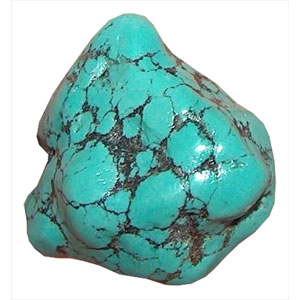 Turquoise used in turquoise jewelry is softer than other stones used in jewelry. Using Mohs scale of mineral and gem hardness, Turquoise is a 5-6 (out of 10). Mohs scale is based on a scale of 1-10, with 10 being the hardest stone which is diamond. The softest of stones will be similar to graphite, which is used in everyday common pencils; obviously very soft. Stones in the range of 1-4 are rarely used for any types of jewelry without being stabilized. Because turquoise is softer than most stones, you must be careful not to store turquoise jewelry in a way that would allow it to be scratched or jarred against other items. For example, storing a turquoise ring in a large drawer with many other rings could cause the turquoise stone to scratch, or even worse, fracture.
For today, a video of a Rainbow Man kachina by K. Largo.  Kachinas such as this, along with all sorts of wonderful turquoise jewelry, can be found throughout the American Southwest.  This Rainbow Man kachina is SKU number: 220648
 And for my final blog in this series, what happens if your turquoise jewelry has become tarnished beyond the help of Hagerty’s Silver Spray polish.  This is typically the scenario if you have purchased a piece in an estate sale or from a pawn shop.  The turquoise jewelry, such as a turquoise ring, may not have been properly cleaned for years, and is beginning to look like wrought iron more than silver!  Don’t despair, it can look as good as new in a very little bit of time.  There are two ways that I usually go about cleaning these pieces.  The first is to use a stronger silver cleaning agent.  These can be easily found at any grocery store; but be careful, these stronger polishes can easily harm or even destroy soft stones like turquoise.  Remember that turquoise, and other commonly used stones (like coral and shell), is relatively soft and porous, so using strong chemicals can damage your jewelry.  I use a Q-Tip almost exclusively with stronger silver cleaners for two reasons.  First, their small size makes it easy to clean the intricate silver work around stones.  Second, the Q-Tip can only hold a small amount of cleaning agent, so I’m almost guaranteed not to use too much.  Follow the directions that came with your cleaning agent and you should get very good results.  Ventilation is almost always strongly recommended with any stronger silver cleaner.  And finally remember to rinse your jewelry with some water before wearing it.  This will ensure that the chemicals used to clean the piece are completely removed.
 Although the above method works well, I don’t care for using the stronger cleaners; mostly because of their smell.  When you clean silver for hours a day, the smell is terrible; and with some cleaners it can be dangerous.  So the second method I’m going to describe for this blog is my preferred method, but is also not going to be the most common for people at home.  I like to use a polishing wheel, like the one pictured.  It’s easy, fast and doesn’t use harsh chemicals.  It’s safe for almost all stones.  The only drawback is its size.  I won’t go into great detail here since most people won’t use this method; and if you have a polishing wheel, you probably already know how to use it.
 The reverse side of most bolo ties will look similar to the one pictured here.  The difficulty with cleaning bolo ties with silver spray is that the spray may not come off of the braided cords.  Therefore, I choose to remove the braided cords and then clean the bolo.  There are two “flaps” of silver that are bent into a circular shape that guide the braided cords down into the clasp.  The clasp is the part that provides the tension to hold the bolo to the corded braids.  To clean the back of the bolo tie if it has become tarnished, I first remove the tips as described in an earlier post.  If the bolo itself needs cleaning, then generally the tips need to be cleaned as well; might as well do them all at the same time.  Once the tips are removed, I move on to the bolo itself.  I start by using a pair of flat (sometimes called “smooth” or “jeweler’s”) pliers.  These pliers are nothing special, you can buy them for around $5 at any craft store such as Michaels or AC Moore.  The only difference is that these pliers’ grabbing surface is perfectly smooth; so as not to mar or damage the silver.  With the pliers in hand, I very gently open up the two “flaps” that hold the braided cord at the top of the bolo.  The goal is to only open them up enough to allow the cord to be removed.  Once they are opened I gently slide the cord up and out of the bolo.  With the tips removed, the braided cord should slide right through the clasp.  After this, it’s business as usual.  Spray the bolo tie, and polish it up.  Putting the bolo tie back together is as easy as reversing the process.  When you’re all done, you will have a brand new, shiny piece of Native American artwork to wear with your favorite shirts.  In the final blog of this series I’ll talk about how I clean turquoise jewelry that has become tarnished beyond the help of Hagerty’s Silver Spray polish.